Project: link h1
Project Overview link h2
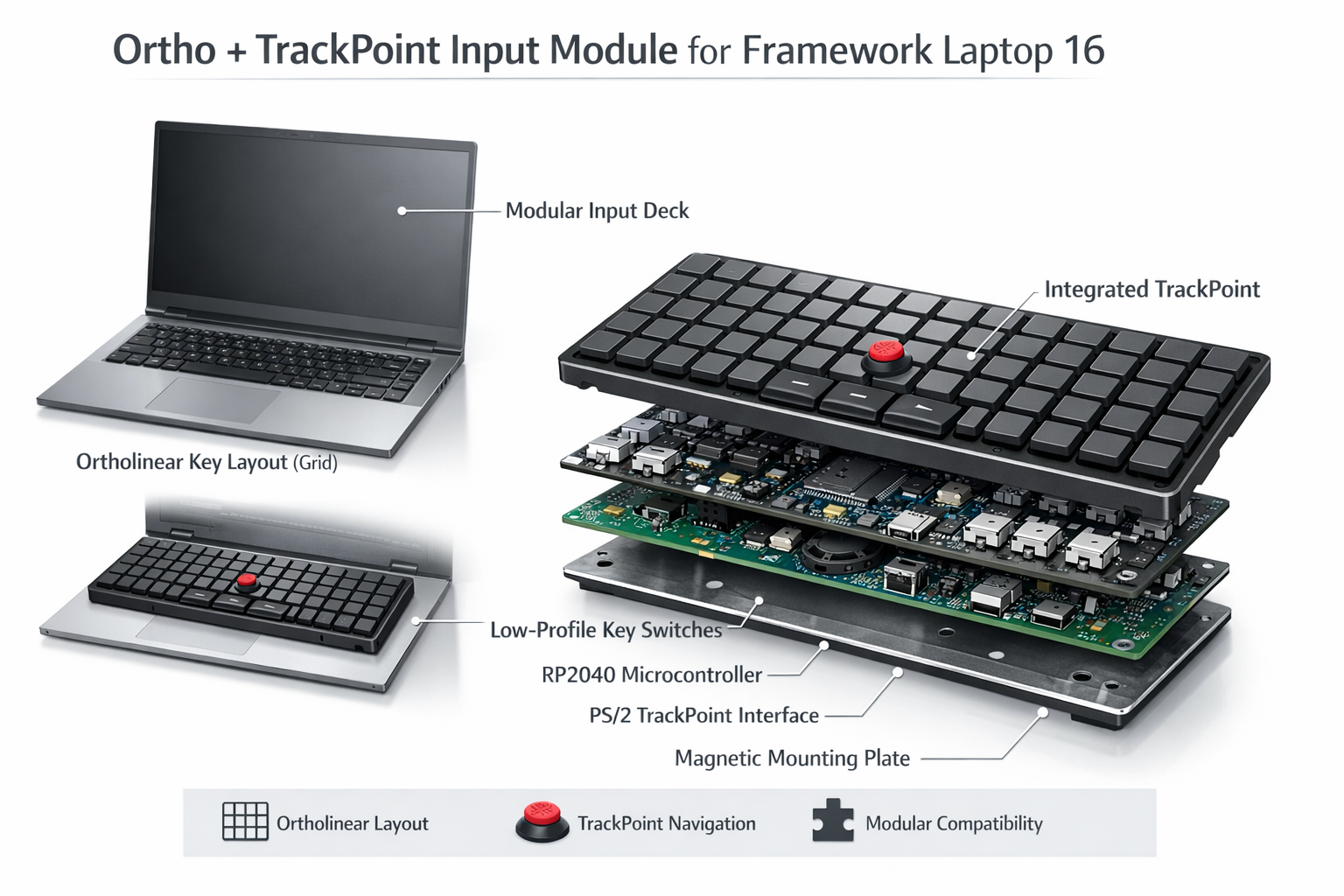
This project aims to design and prototype a keyboard-sized input module for the Framework Laptop 16 that combines:
- An ortholinear laptop keyboard layout
- An integrated TrackPoint-style pointing stick
- Dedicated mouse buttons
- Full compatibility with Framework’s Input Module ecosystem
Rather than a standalone keyboard, this device is designed as a drop-in replacement input module, using Framework’s pogo-pin interface and USB HID architecture.
The long-term goal is to deliver a functional, ergonomic, and community-validated input module that aligns with Framework’s modular and repairable hardware philosophy.
Problem Statement link h2
Current laptop keyboards prioritize familiarity and mass-market ergonomics. Power users who prefer:
- Ortholinear layouts
- Keyboard-centric navigation
- TrackPoint-style pointing devices
have no native option within the Framework ecosystem.
This project explores whether such an input method can be:
- Mechanically viable within Framework’s constraints
- Electrically compliant with the input module specification
- Comfortable for sustained daily use
- Manufacturable at small to medium scale
Design Constraints link h2
Platform Constraints link h3
- Target platform: Framework Laptop 16
- Module type: Keyboard-sized Input Module
- Interface: USB 2.0 over pogo pins
- Power: Limited by Framework input module power budget
- Enumeration: Composite USB HID (keyboard + mouse)
Mechanical Constraints link h3
- Fixed module outline and mounting points
- Magnet-based retention system
- Strict Z-height limits across the entire key field
- TrackPoint cap height must not interfere with adjacent keys
Electrical Constraints link h3
- RP2040-class microcontroller preferred for ecosystem compatibility
- TrackPoint sensor operates via PS/2-style signaling
- Board ID resistor required for module identification
- ESD protection required on USB and exposed interfaces
Core Design Goals link h2
Ortholinear Key Grid
- Uniform column alignment
- Laptop-grade scissor or equivalent low-profile mechanism
- Layout optimized for typing efficiency over legacy conventions
Integrated TrackPoint
- Centered or near-centered placement
- Low-profile cap (≈2–4 mm)
- Tunable sensitivity and acceleration
- Works without removing hands from home row
Native Framework Integration
- No external dongles or cables
- Fully recognized by Framework firmware and OS as standard HID
- Installable and removable like any other input module
Open and Iterative Development
- Public documentation of design decisions
- Community feedback incorporated early
- Firmware and hardware structured for maintainability
Development Phases link h2
Phase 0: Research and Specification Alignment link h3
Objectives
- Fully understand Framework Input Module electrical and mechanical specs
- Identify TrackPoint sensor options and availability
- Validate firmware paths (QMK, PS/2 support, composite HID)
Deliverables
- Annotated input module spec notes
- TrackPoint electrical interface reference
- Preliminary layout sketches
- Risk register (height, sourcing, firmware complexity)
Phase 1: TrackPoint + Controller Proof of Concept link h3
Objectives
- Prove TrackPoint functionality within Framework constraints
- Validate PS/2 to MCU integration
- Establish firmware baseline
Scope
- Small prototype PCB (non-keyboard-sized)
- RP2040 microcontroller
- TrackPoint sensor and mouse buttons
- USB enumeration as composite HID
Deliverables
- Working TrackPoint inside Framework laptop
- Firmware repository with basic configuration
- Measured power consumption
- Ergonomic notes on stick height and placement
Phase 2: Mechanical Keyboard Feasibility link h3
Objectives
- Determine feasibility of ortholinear laptop key mechanisms
- Establish row/column pitch
- Validate typing feel and stability
Scope
- Mechanical mockups using:
- Salvaged laptop scissor mechanisms, or
- Early Framework one-key modules if available
- Plate and backer experiments
- No electronics beyond basic matrix testing
Deliverables
- Key layout decision
- Plate stack design
- Typing and noise evaluation
- Confirmed Z-height margins
Phase 3: Integrated Keyboard + TrackPoint Prototype (v1) link h3
Objectives
- Combine keyboard matrix and TrackPoint into a single input module
- Validate full system behavior inside the laptop
Scope
- Keyboard-sized PCB
- Full ortholinear matrix
- Integrated TrackPoint and mouse buttons
- Magnet retention and steel backer
- QMK-based firmware with VIA support
Deliverables
- Fully functional prototype module
- Layout files and firmware configuration
- Assembly documentation
- Known issues list
Phase 4: Refinement and User Testing link h3
Objectives
- Improve ergonomics, firmware tuning, and reliability
- Validate real-world usability
Scope
- Iterative PCB revisions if needed
- TrackPoint sensitivity tuning
- Extended typing and navigation tests
- Small number of external testers
Deliverables
- Revision notes and changelog
- User feedback summary
- Finalized layout and firmware defaults
Phase 5: Production Readiness Assessment link h3
Objectives
- Determine viability beyond prototyping
Scope
- Manufacturing considerations
- Assembly complexity analysis
- Cost estimation at low volumes
- Framework Marketplace alignment
Deliverables
- Production feasibility report
- Final BOM
- Go / No-Go decision for small-batch production
Success Criteria link h2
The project is considered successful if:
- The module installs cleanly into a Framework Laptop 16
- The keyboard and TrackPoint function reliably as a single HID device
- Typing and pointing can be performed without hand repositioning
- No thermal, power, or interference issues are introduced
- The design is documented well enough for others to reproduce or extend
Project Status link h2
Current Phase: Phase 0 – Research and Specification Alignment
Next Milestone: TrackPoint + RP2040 proof of concept operating inside Framework input deck
Participation and Contribution link h2
This project is exploratory and open to collaboration. Contributions may include:
- Mechanical design feedback
- Firmware improvements
- Ergonomic testing
- Documentation and validation
Updates will be shared as the project progresses.