Overview link h2
This project is a focused proof of concept for a training certificate management and verification platform designed for independent consultants and professional trainers.
The goal of the POC is to validate one core idea:
A consultant can issue, manage, and verify professional training certificates through a single reliable system, while third parties can independently verify those certificates without contacting the consultant.
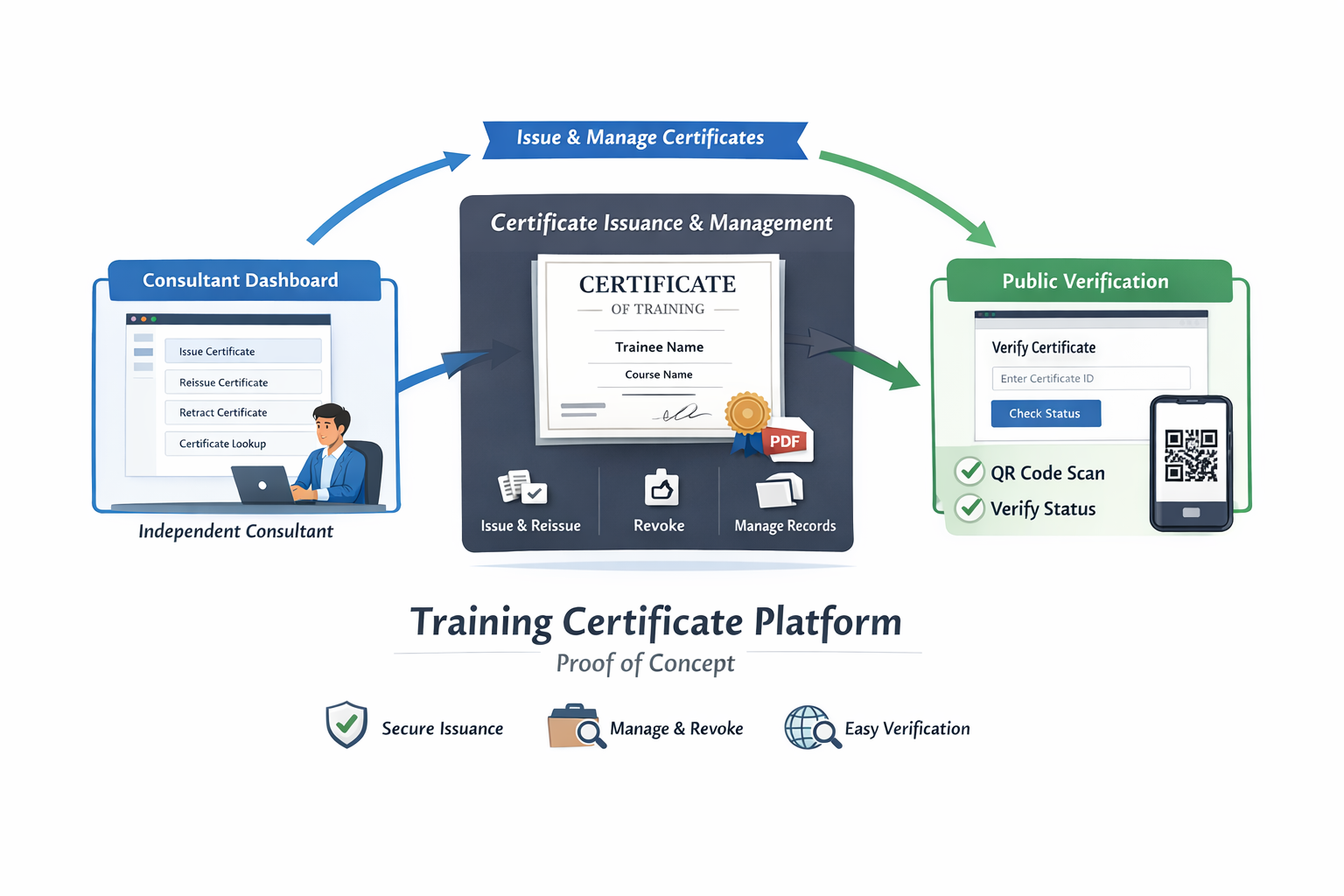
This proof of concept is being built in collaboration with a single consultant partner and reflects real-world training workflows.
Problem Statement link h2
Independent consultants who provide professional or compliance related training often face recurring challenges:
- Certificates are generated manually using templates or PDFs
- Records are stored across spreadsheets, folders, or email threads
- Reissuing or correcting certificates is time consuming
- Retracting certificates requires manual communication
- Verification requests interrupt normal work
- There is no centralized source of truth for issued certificates
These issues introduce operational overhead, reputational risk, and verification friction for both trainers and their clients.
POC Scope and Philosophy link h2
This proof of concept focuses on depth, not breadth.
Rather than supporting many consultants or complex automation, the POC demonstrates a complete and trustworthy certificate lifecycle for a single consultant partner.
The POC assumes:
- One consultant
- One administrator account
- Manual setup
- No self service onboarding
- No payments or billing
- No marketing or sales tooling
Every feature included directly supports certificate issuance, management, or verification.
What the POC Includes link h2
Consultant Capabilities link h3
The consultant can:
- Log in to a secure admin interface
- Create and manage training sessions
- Add trainees to a session
- Issue certificates to trainees
- View a centralized list of all issued certificates
- Reissue certificates when corrections are required
- Retract certificates when they are no longer valid
- Look up and verify certificates directly within the admin interface
Certificate Lifecycle Management link h3
Each certificate supports the following states:
- Issued
- Reissued (with revision history)
- Retracted
The system maintains an authoritative record of the current status of every certificate.
Certificate Capabilities link h2
Each issued certificate:
- Has a unique certificate identifier
- Is generated as a signed PDF
- Includes trainee name, training name, issue date, and issuing consultant
- Contains a QR code linking to a public verification page
- Can be invalidated without deleting historical records
Reissued certificates preserve the original certificate record while clearly indicating the latest valid version.
Public Verification link h2
Any third party can:
- Visit a public verification page
- Scan a QR code or enter a certificate identifier
- Confirm whether the certificate is valid, reissued, or retracted
- View basic certificate metadata and issuing authority
Public verification requires no authentication.
Consultant Verification and Lookup link h2
In addition to public verification, the consultant can:
- Search certificates by trainee name, certificate ID, or session
- View certificate status and history
- Manually verify certificates during audits or client inquiries
- Confirm whether a certificate has been reissued or retracted
This allows the consultant to respond confidently to verification requests without relying on external tools or memory.
What the POC Explicitly Does Not Include link h2
The following features are intentionally excluded:
- Payments or billing
- Multiple consultants or tenants
- Branding customization
- Email automation
- Course catalogs
- Attendance tracking
- Certificate expiration or recertification logic
- Role based access control
- Public marketing pages
These are considered future product concerns, not validation requirements.
Technical Stack link h2
The proof of concept is built using:
- Frontend: React (Next.js)
- Backend: Node.js (Fastify)
- Database: PostgreSQL
- Certificate Generation: HTML to PDF rendering
- Verification: Cryptographic signature validation
- Deployment: Docker Compose for local development
The system is designed to persist data reliably and support real demonstrations.
Simplified Architecture link h2
Backend Responsibilities link h3
- Consultant authentication
- Training session and trainee storage
- Certificate issuance and reissuance
- Certificate revocation handling
- PDF generation
- Certificate signing and validation
- Public and internal verification endpoints
Frontend Responsibilities link h3
- Consultant admin interface
- Session and trainee management
- Certificate list and management views
- Certificate lookup and verification UI
- Public verification page
POC Data Model (Simplified) link h2
The POC uses a minimal but complete data model:
users
Stores the consultant administrator accountsessions
Represents a training sessiontrainees
Represents individuals trained in a sessioncertificates
Stores certificate records, status, revision history, and verification data
All data is scoped to a single consultant.
POC Development Phases link h2
Phase 1 – Foundation link h3
- Project setup and repository structure
- Database connection and migrations
- Consultant authentication
- Health and sanity check endpoints
Phase 2 – Core Workflow link h3
- Training session creation
- Trainee management
- Certificate issuance
- Certificate listing and status management
Phase 3 – Certificate Management and Verification link h3
- Reissue and retract flows
- Consultant certificate lookup
- Public verification endpoint
- QR code integration
Phase 4 – Demo Readiness link h3
- UI cleanup
- Error handling
- Sample data seeding
- End to end demo testing
Success Criteria link h2
This proof of concept is considered successful if:
- The consultant can manage certificates without manual workarounds
- Certificate corrections and revocations are simple and auditable
- Verification is fast and unambiguous for both consultants and third parties
- The system feels reliable and authoritative during a live demo
- The consultant expresses interest in continued use or expansion
The POC is not intended to validate growth, pricing, or automation.
Next Steps After the POC link h2
If the proof of concept demonstrates value, future work may include:
- Multi consultant support
- Branding and customization
- Certificate expiration and recertification
- Payment processing
- Corporate client management
- Audit logs and reporting
These features will be pursued only after validation.
Current Status link h2
This project is currently in the proof of concept phase and under active development.
Feedback from real-world use will directly inform future iterations.