Expanding the Combat Queue: A Four-Action System link h1
Overview link h2
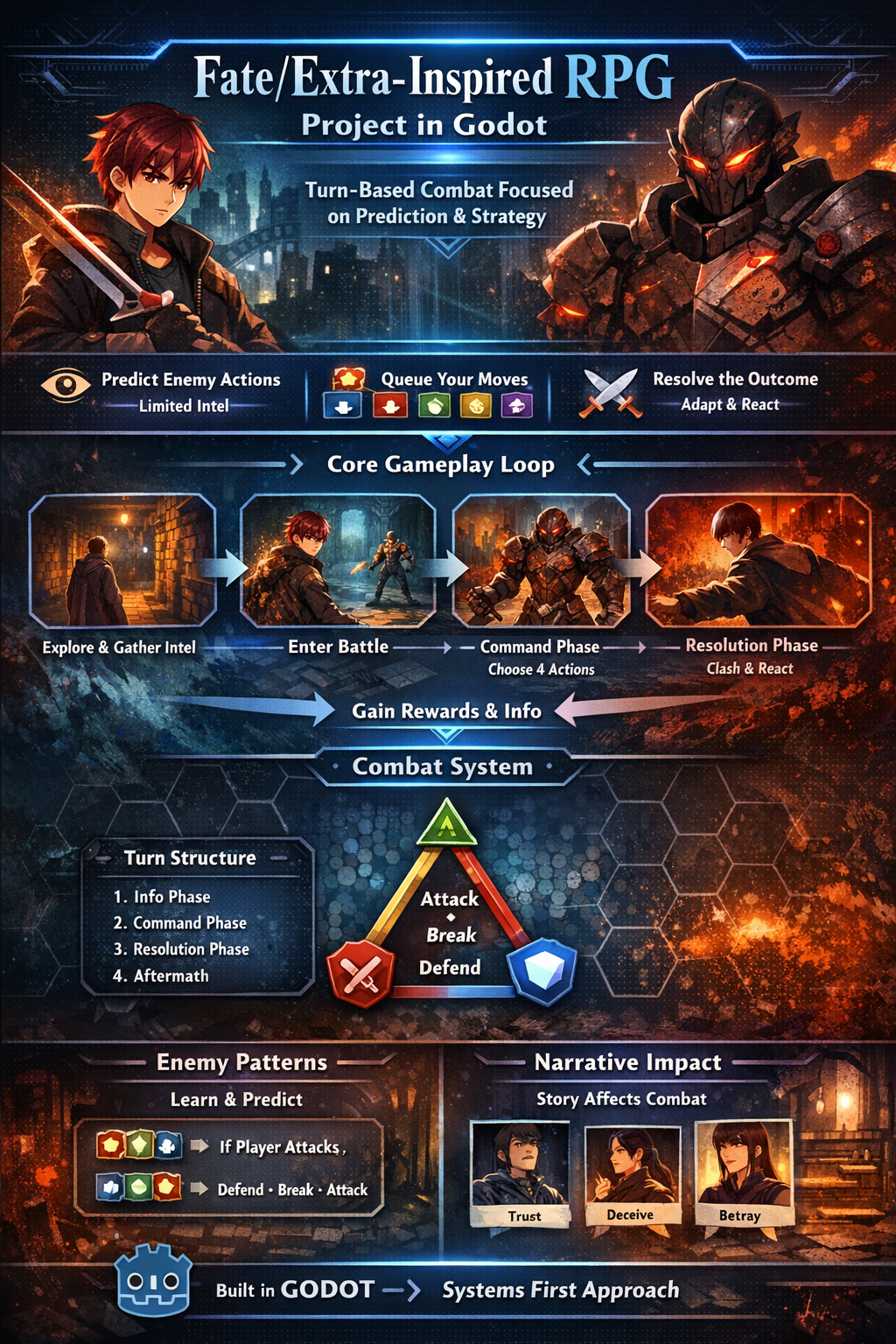
This project is an RPG that uses a Fate/Extra–inspired combat system built around commitment, prediction, and limited information.
Players and enemies select actions in advance, then watch them resolve step by step. Victory depends less on raw stats and more on reading intent and exploiting patterns.
Core Action Triangle link h2
Combat is built on a simple, readable interaction model:
| Action | Defeats | Is Defeated By |
|---|---|---|
| Attack | Break | Defend |
| Defend | Attack | Break |
| Break | Defend | Attack |
Each turn consists of four micro-rounds, resolved sequentially using this triangle.
Turn Flow link h2
1. Information Phase link h3
The player receives partial insight into enemy intent. This may include:
- A confirmed action in one slot
- Probabilities for certain actions
- Behavioral tells revealed through story or prior encounters
Perfect information is never granted. Uncertainty is intentional.
2. Command Phase link h3
The player commits to four actions in order.
- Actions cannot be changed once confirmed
- The full sequence represents the player’s tactical intent for the turn
- Advanced abilities may later allow limited manipulation of the queue
3. Resolution Phase link h3
Actions resolve one slot at a time:
- Player action vs enemy action
- Outcome determined by the action triangle
- Damage, mitigation, and effects applied
- Momentum or streak modifiers updated
Each micro-round feeds into the next.
4. Aftermath Phase link h3
- Health and status updates
- Intel progression
- Narrative or behavioral flags adjusted
Strategic Impact of the Fourth Action link h2
Long-Form Mind Games link h3
With four actions, both sides can:
- Probe early
- Feint in the middle
- Punish late
- Recover or stabilize at the end
This creates encounters that feel intentional and adversarial, not reactive.
Risk Distribution link h3
| Player Strategy | Result |
|---|---|
| Defensive early slots | Safer reads, lower damage |
| Aggressive opening | High payoff, exposed ending |
| Mixed deception | Strongest long-term outcome |
The fourth slot often becomes the decisive moment, where overconfidence or hesitation is revealed.
Enemy Design with Four Actions link h2
Enemies are designed around recognizable but exploitable patterns.
Example Pattern Logic link h3
Patterns are intended to be learnable over time.
Intel and Information Systems link h2
Information is a core resource.
Possible intel outputs include:
- Partial action reveals
- Slot-specific tendencies
- Behavioral tells tied to narrative events
- Pattern fragments discovered through repeated encounters
Higher-level enemies may introduce false signals.
Narrative Integration link h2
Narrative choices directly affect gameplay systems.
Examples:
- Dialogue decisions influence enemy behavior
- Alliances unlock clearer tells
- Betrayals introduce misinformation
- Story flags modify available player abilities
Narrative is used to justify mechanical changes rather than existing separately.
Technical Architecture (Godot) link h2
Key Principles link h3
- Data-driven design
- Clear separation of logic and presentation
- Deterministic combat resolution
Core Components link h3
- Battle Manager: turn flow and resolution
- Player Controller: input and queue construction
- Enemy Controller: pattern evaluation
- UI Layer: visualization only
Enemy and player data are defined using Godot Resources for flexibility and reuse.
Scope and Constraints link h2
- Single-player only
- Turn-based only
- No procedural generation in early phases
- Systems stability prioritized over content volume
Open Design Questions link h2
- How much misinformation is acceptable before frustration outweighs challenge?
- Should bosses follow the same rules as standard enemies?
- How visible should enemy intent be by default?
These questions will be answered through prototyping and playtesting.